How To Format An External Hard Drive For Mac High Sierra
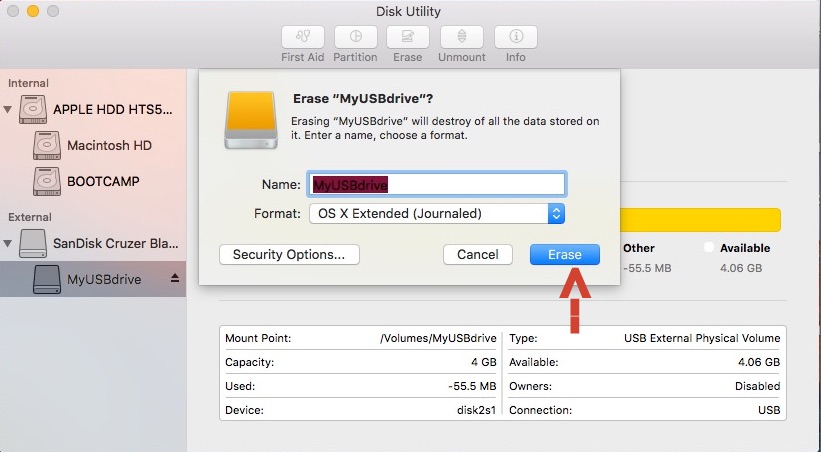
But I’m giving this tutorial for both Mac & PC. So, you can use your external hard drive for both. So, Now 1st select Mac OS Extended (Journaled) Format & Select GUID Partition Map scheme.Now click on Erase. It will take around 5-8sec to erase.
2:55 If you've considered these issues and would still like to use FAT32, this video will guide you through the process of formatting your HD to FAT32 using a Windows or Mac PC: OK, what are my alternatives to using FAT32? The good news is, it's not FAT32 or nothing. The alternative solutions do require more tinkering, but if you do not want to risk FAT32's lack of security, choose from one of the following alternatives. Option 1: Format to NTFS, and use NTFS-3G to read/write on Mac.
It does its job too perfectly. It deactivates applications on valid machines booting with valid clones made with Carbon Copy Cloner. Can’t really blame engineers for protecting engineers from thieves.
Why You Probably Don’t Want to Use APFS Yet RELATED: The new Apple File System is currently experimental. Apple is targeting a final release in 2017, and your Mac’s system drive–and the drives inside iPhones, iPads, Apple TVs, and Apple Watches–should automatically convert to APFS at that point. For now, the only reason to format a drive with APFS is to experiment with it. However, APFS is in development, so benchmarks performed with it may not be representative of the file system’s final performance. Apple also warns that drives formatted with this prerelease version of APFS may not be compatible with future versions of macOS and the final version of APFS. Don’t use an APFS drive for anything important.
• Click the Erase tab along the top of the window. • From the Volume Format menu, choose Mac OS Extended (Journaled).
Step 1 Go to Finder to open the window, and from the left side, select Applications. Step 2 From the applications Window, find and click Utilities, and from there, go to Terminal. Step 3 Now, remember the name that you set for formatting your external drive (i.e.
Your Mac includes Disk Utility, an app that can erase disks, add volumes, check disks for errors, and more. Erasing a disk or volume permanently deletes all of its files.
• Click on Finder in your Dock to open a Finder window. • Select Applications from the list on the left side of the window. • Scroll down and double-click on Utilities. • Scroll down and double click on Terminal. • Recall the name of your when entering the following text into Terminal. If it is not named 'Untitled,' you will need to change the command syntax for the pathname where it says: Volumes/Untitled. The name of the drive can't have any spaces and it is case sensitive.
Once complete, click done. For additional help see.
Format a volume for Mac in macOS Sierra using Disk Utility • Security Options will allow you to erase the Volume securely by overwriting the contents of the drive upto seven times before removing the header information from files and folder. When you click on security option, you get a new pop up window with a slider to adjust the level of security ( in terms of data overwrite) while erasing the disk. This secure erase will make it almost impossible to recover the contents or data of the hard drive using any data-recovery software. But secure erase will take ages to complete, depending upon the size of the volume.
• Click Erase. • Click Done when the process is complete.
In old DU it creates all four partitions the sizes you specify and formats them in sequential order. The latter is blindingly fast compared to all those resizing steps which take forever. I also have yet to use step-by-step directions, specifying exact partition sizes on two disks and have them create partitions the same size on both disks. Every time DU resizes a partition it ends up at “about” the right size, rarely exactly the size you specify.
MacOS Sierra is a fantastic update arriving from Apple to make us love our Macs even more. It has plenty of new features, and also has the same easy clean install and upgrade flow as did the previous OS. LEARN MORE: Note, that getting an upgrade is the easiest way of installing the new macOS. It saves all your personal files, apps and user data, while a so-called clean install of Sierra will erase all data on the startup drive and replace it with a clean copy of OS.
You may wish to use an external FireWire or USB hard drive to store your Aperture Library, referenced images, or Vaults. Here are some suggestions on preparing the external hard drive for best performance with Aperture. Many external hard drives come pre-formatted as FAT 32. This is a native Windows file format that can be read by Mac OS X, but is not ideal for use with Aperture.
Who says the optical drive is dead? Optical storage offers a great way to archive data long term, and Blu-ray media offers a tremendous amount of storage in a single disc. Watch Blu-ray movies to experience near studio master image quality. Our award-winning U.S. Based customer service is at the ready to help you with any upgrade questions you may have. We're available online and on the phone 24/7. Say hello today and find out what your Mac can do.
Agree to the software terms and conditions. Choose your hard drive.
The installation process will begin. Follow the steps to install macOS High Sierra onto your Mac or partitioned hard drive. Do you have any questions about how to create a bootable installer drive for macOS High Sierra?
Internal Hard Drive For Macbook Pro
At startup, it’s possible to select which operating system is to be loaded. Photo editor for mac dog logo. • Running beta operating systems in their own boot partition. During the macOS Sierra beta, my “test machine” was partitioned with Mac OS X El Capitan on one partition and on another.
• Launch Disk Utility from the Recovery startup list. • Control-click the new main partition on your new drive and choose Restore. • Select your old drive’s main partition in the Restore From menu and click Restore.
Format An External Drive
How to format your external drive for Mac You'll need to start with a clean thumb drive or hard drive in order to get it ready to work as a bootable drive. • Plug the USB end of the drive to a USB port on your Mac. • Click on Finder in your Dock to open a Finder window.